The words below reflect the history of nuclear power in the last seven decades, through personal snapshots from Ruud Lubbers’ memory. As the former Prime Minister of the Netherlands, Ruud Lubbers shared these reflections during the pre-conference of the Nuclear Security Summit, which is currently taking place in The Hague and bringing together more than 50 world leaders to discuss the prevention of nuclear terrorism.
“While the Nuclear Summit has started in The Hague, a few snapshots out of my “nuclear” diary revived.
Born in The Netherlands, seventy five years ago, I grew up with the vivid memory that the Second World War ended in Japan with the “Atoombom” (Atom bomb). This is my first snapshot.
Nevertheless, when I as an eighteen year old boy visiting the Euratom Exhibition in Brussels, I was very positive about nuclear; its potential for human health (isotopes) and for the production of electricity. This is my second snapshot.
My third snapshot is fifteen years later. It dates 1973. I became a young Minister for Economic Affairs and Energy. Under this snapshot, forty years ago, I wrote about “The first oil crisis”. In those years, OPEC had embargoed the USA and the Netherlands. OPEC failed. It gave me an opportunity to prove to be a successful minister and politician that year and subsequently twenty one years thereafter.
My fourth snapshot is a short time later, in 1975, as the young minister that founded the Dutch Energy and Nuclear Research Center. In those days I learned that Professor Kistemaker had after the Second World War developed another technology to enrich uranium. I am talking about the now well-known gas centrifuges. Together with our German and English friends we created URENCO.
The fifth snapshot from my personal nuclear (photo)album is a remarkable one, under which I penciled Mr Kahn in 1975. He studied engineering and subsequently worked for a subcontractor, working at the company that translated Kistemaker’s findings into a profitable business, Urenco. I remember vividly the very day that at my Ministry it was said “Mr. Minister, we have detected a spy”.
As the Dutch were not allowed to look into this “security” matter, we had to leave this to American and British intelligence. The American and British intelligence considered themselves as competent and qualified in matters of security.
Frankly speaking, in the years thereafter, all the way up to the years I was Prime Minister, I became increasingly amazed that these services focused on intelligence and not on action.
That attitude has given room to the “Khan network”. Of this network I have no snapshot in my personal nuclear diary. I should have travelled to countries like North Korea, Libya, Iraq and so on to collect them. I did not.
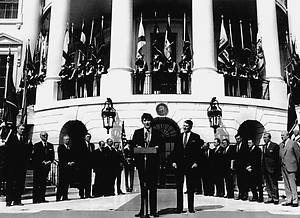 No, my sixth snapshot is taken in Washington DC, January 1983. It shows President Reagan and me as a young Dutch Prime Minister. I was there to talk about NATO, or more specifically the Soviet threat to “finlandize” West European countries with SS20 missilesystems. These were not meant for strategic nuclear forces but for intermediate nuclear forces.
I just mentioned to “finlandise”. This expression, well known in those days, was used to indicate effective political influence without military action.
This sixth snapshot is my favourite; because there Reagan confided to me his ambition to go for zero-zero with the intermediate forces. There, in Washington, he said to me “Ruud, to get this done we have to let the commies sweat first”.
This brings me to my seventh snapshot. That is a photo of Ronald Reagan together with Michael Gorbachev in Reykjavik 1986. There they agreed on zero-zero and that was part of the beginning of the end of the Cold War.
My eighth snapshot is about Tsjernobyl. Yes, that happened the same years. After the famous Three Mile Island accident in Pennsylvania USA: again a drawback for me as a nuclear positivist – and that just before the first time that I had to be re-elected in 1986 as Prime Minister of the Netherlands. I remember vividly that my then Minister for the Environment did a great job to calm down our farmers not to become too nervous about radio-activity coming down all the way from Tsjernobyl on Dutch grasslands.
My photo album on nuclear ends too early. Otherwise it would contain the more recent tsunami disaster in Japan, which rocked the trust of the public at large in nuclear energy.
Firstly in the USA, then in Tsjernobyl and then in Japan. Every few decades I have experienced nuclear accidents. For me, a nuclear positivist, this is also part of my life.
Going back to the eighties of the last century my next snapshot is of George Bush, Vice President under Ronald Reagan. He became known as Father Bush. His son invaded Iraq to go after nuclear military capacity.
You all will recall Colin Powell, the then American Secretary of State in the U.N. Security Council, first motivating military action and then later apologizing for the wrong information.
Those days I was part of the U.N. Family, as a High Commissioner for Refugees. That gave me the opportunity to sit down with Mohamed El Baradei, in charge of the International Atomic Energy Agency in Vienna. Mohamed interviewed me about the Khan history and I used this opportunity to question him about “yes or no” nuclear capacity in Iraq ?
When I returned to the Netherlands I continued my link with El Baradei and the IAEA; the Nobel Prize winner.
My journey with nuclear went all the way from Petten and Urenco, to ten years ago, becoming sort of family of the International Atomic Energy Agency in Vienna.
My next snapshot shows three Americans; Kissinger, Shultz and Scowcroft. These “have beens” from the years of President Reagan and Father Bush created a new awareness on nuclear arms some time ago, eventually resulting in the “global zero movement” these days.
The next snapshot dates from January 2010. It shows four Dutch Ministers of State; Max van der Stoel, Hans van Mierlo, Frits Korthals Altes and myself. The two former Foreign Ministers passed away a couple of years ago already, Korthals Altes and myself are still around. The last paragraph of what this Dutch “Group of Four” published those days reads :
“The significance of the action of the first “Group of Four” (Kissinger, Nunn, Schultz and Perry) lies in the fact that during the time they held responsibilities in the government, they used the threat of nuclear weapons as a means to maintain peace. Though it is unusual, we as (Dutch) “policy veterans” consider this to be the right moment to speak out and join our former colleagues in their call for a world without nuclear weapons.”
These “alarm bells” of American and Dutch have beens as well as of similar initiatives in other NATO-members, are ringing loudly at the very same time that President Obama feels obliged to combine arms control with modernization of nuclear arms.
I use this opportunity to applaud President Obama for his effort to explore diplomacy and partnership with Iran after decades of no diplomacy at all; a sort of new Reykjavik.
My last snapshot is about Angela Merkel, the “Ossie” who succeeded Helmut Kohl. After all she is my neighbour; and immediately after the coming down of the Berlin Wall I was able to connect with her. More recently after Fukushima, she went “für die Energiewende” in Germany, phasing out nuclear energy in her country.
With all my commitment to “global zero” when we talk about nuclear weapons, I still have not lost my positive attitude towards electricity generated by nuclear technology. With all my sympathy for renewables to reduce climate change risks, I wonder whether “our common future”, which is the responsibility for generations to come and for their essential need of electricity, should not require such a level of nuclear safety and security that nuclear can play its role in a responsible way.
All in all, the seven and a half decades I have lived and worked with nuclear technology were very real and confusing for me; in its safety dimensions, but even more when it comes to its ongoing security dimensions.
As a politician, I grew up with the Non Proliferation Treaty, with a Security Council of the U.N., composed of the haves and the have-nots, and with an International Atomic Energy Agency.
I do hope the deliberations of the preconference to the Nuclear Summit contribute to a common future for the generations to come, not based on traditional power structures but on common organized security.
The high level attention given to securing nuclear materials, as demonstrated by bringing together Heads of State and Government at the summit level, is important. However, this conference does not address the urgent need to accelerate pace on nuclear disarmament, nor does it consider legally binding steps to ensure a nuclear weapons free world.
While this conference on security might be valuable, I allow myself to conclude with my dream of nuclear security really serving mankind. Many politicians scientists and nuclear industry representatives convene these days for that purpose. Brains and ethics are required; and let me wish you what is needed most, as expressed in the last words of the Earth Charter:
“The joyful celebration of life”.”
NB Would you like to read more about eliminating the threat of nuclear powers and the summit? Here is an interesting article by Thalif Deen, UN Bureau Chief and Regional Director IPS North America.
Hoe het Earth Charter zich manifesteert
in Earth Charter, UncategorizedLaten we weer wat meer navigeren op de sterren en niet alleen op de lichten van passerende schepen. De prestatie indicatoren van onze economie zijn toe aan een reset. Winst is pas winst als ook aarde & mensheid winnen. Duurzaamheid blijft modieus geneuzel zolang we onze winstdefinitie niet drastisch uitbreiden. Aan de vooravond van belangrijke keerpunten in onze samenleving is leiderschap gevraagd dat het lef heeft zich te laten inspireren door de krachten die integreren in plaats van fragmenteren.
Transparante informatie over voeding met QR codes
Met Nature & More vertegenwoordigen wij vanuit onze biologische groente- en fruitgroothandel , de belangrijke ‘duurzaamheid = transparantie’ waarden uit het Earth Charter. Nature & More voorziet Eosta’s duurzame landbouwprojecten en producten wereldwijd van een gezicht in de markt. Product specifieke Nature & More QR codes geven de consument toegang tot het unieke verhaal van de producent en zijn maatschappelijke impact. Nature & More maakt voedingsketens transparant en ‘empowert’ zo producenten wereldwijd om ook hun ecologische en sociale prestaties te kunnen verzilveren, in plaats van deze verloren te zien gaan in de anonimiteit van de markt.
The Soil is the Limit – Organic is a Soilution – Let’s become Soilmates.
Mijn wens voor 2015 lijkt uit te komen. Het is namelijk het jaar van UN Year of Soils.
Samen met Earth Charter, FAO en vele NGO’s zullen Eosta, Nature & More in Juni 2015 het internationale congres Celebrating Soil organiseren met als hoogtepunt een Soil-Manifest dat naadloos aansluit bij het handvest van de aarde. Wordt ook een Soilmate!
-Volkert Engelsman
Er is nog plek: Earth Charter Masterclass on Education
in UncategorizedGraag geïnspireerd aan de slag in het onderwijs en levenslang leren? Van 13 t/m 17 oktober 2014 vindt de Earth Charter Masterclass on Education and Values for Sustainability plaats. Het centrale thema: “Teaching what really matters”.
Het Earth Charter benadrukt het belang van de integratie van kennis, waarden en vaardigheden die nodig zijn voor een duurzaam bestaan in het formele en levenslange leerproces. Dat is precies waar deze Masterclass voor bedoeld is. Het is een kans voor al diegenen in het onderwijs die graag geïnspireerd worden. Tijdens de Masterclass ondervinden we hoe de waarden en principes zoals verwoord in het Earth Charter in het onderwijs tot leven kunnen worden gebracht. Er is nog plaats, mocht je interesse hebben, neem dan zo spoedig mogelijk contact op (contactgegevens onderaan).
Internationaal aanbod in Nederland
De 5-daagse Engelstalige Masterclass is ontwikkeld is Costa Rica binnen het Earth Charter Education Centre en wordt nu voor het eerst ook in Nederland aangeboden. Het wordt gedragen door Mirian Vilela, UNESCO-leerstoelhouder en directeur van het Earth Charter Secretariaat uit Costa Rica en Sam Crowell, Professor Onderwijskunde en Duurzaamheid aan de University of California.
Mensen die het programma in Costa Rica hebben gedaan zijn erg enthousiast, dat is te zien en beluisteren op de video’s van het Earth Charter Education Centre. Deelnemers zeiden een holistische benadering van onderwijs te hebben leren kennen. Anderen geven aan de manier van onderwijs geven nu te willen veranderen om een bijdrage aan een betere wereld te leveren. Iemand noemde de cursus ‘mind and heart changing’. Ook wordt gezegd dat iedereen zich kan identificeren met de waarden en principes van het Earth Charter.
Over het Earth Charter
Het Earth Charter is een document én een mondiaal maatschappelijk initiatief. Het Earth Charter is ontstaan uit een wereldwijde dialoog met alle actoren in de samenleving. In het jaar 2000 werd het Earth Charter gelanceerd, in het Vredespaleis in Den Haag. Het omvat fundamentele waarden en principes die nodig zijn om in de 21e eeuw een rechtvaardige, duurzame en vreedzame wereld te realiseren. De Earth Charter-principes kleuren ‘duurzame ontwikkeling’ in met begrippen als menselijke waardigheid, respect, vrede en democratie, ecologische integriteit, sociaal-economische gelijkwaardigheid en rechten van vrouwen. Het Earth Charter is relevanter dan ooit. In een tijd waarin een grote verschuiving in ons denken en doen vereist is, zijn de fundamentele gedeelde waarden uit het document een belangrijk kompas.
Programma en samenwerkingspartners
Het Masterclass programma biedt de kans om de rol van onderwijs in het bewerkstelligen van duurzaamheid te verdiepen. Binnen de UNESCO Leerstoel over Onderwijs voor Duurzaamheid, ondergebracht bij Earth Charter International, wordt kennis bijeen gebracht en ervaring opgedaan met de ontwikkeling van een andere pedagogische benadering gericht op een duurzame wereld.
Het programma introduceert het concept duurzame ontwikkeling en de implicaties voor onderwijs, leren en verandering. Het onderzoekt praktische methoden om waarden en principes voor duurzaamheid, zoals verwoord in het Earth Charter, op een geïntegreerde en holistische wijze in te brengen in scholen en klaslokalen.
Het programma komt tot stand in samenwerking tussen Earth Charter Internationaal, Earth Charter Nederland (Iona Stichting, Inner Sense en Earth Charter Vrienden) en de Academie voor Marketing en Businessmanagement AVANS Hogeschool Breda.
Voor meer informatie over het programma, zie de website van Earth Charter Nederland: http://www.earthcharternederland.nl/
Locatie en aanmelden
Onze inspirerende locatie: Landgoed ISVW (Internationale School voor de Wijsbegeerte) in Leusden.
Het aanmeldingsformulier is aan te vragen of op de website van Earth Charter Nederland te vinden: www.earthcharter.nl Daar is ook een globaal overzicht van het programma te vinden. Kosten per deelnemer: € 2.500. We bieden de mogelijkheid om deel te nemen zonder overnachting, ontbijt en diner. In dat geval bedraagt de Masterclass € 1.950.
Om in aanmerking te komen voor deelname aan de Masterclass gelieve het ‘application form’ insturen en bij interesse z.s.m. contact opnemen. Contact: Alide Roerink (Earth Charter Vrienden): [email protected]. Telefoon: +31 (0) 612479450.
Hoe Wubbo Ockels en ik duurzaamheidsvrienden werden
in Earth CharterRotterdam, 19 mei 2014
Wubbo Ockels heb ik zoals veel Nederlanders leren kennen door zijn reis in de ruimte. Terug op Aarde werd hij de man van de duurzaamheid en vonden wij elkaar in het Earth Charter (Handvest van de Aarde). We keken elkaar aan en wisten waarover we het hadden. We kregen persoonlijke bewondering voor elkaar.
Zo reisden we in 2006 met ‘Lowlands University on Tour’ naar jongerencentra in heel Nederland om colleges te geven over het Earth Charter en de rol van jongeren bij het bewerkstelligen van duurzaamheid. Wubbo deed fantastisch werk samen met de studenten. Ikzelf was zo ongeveer de eerste berijder van een volledig elektrische personenauto. De elektrische auto vonden we beiden de moeite waard.
Wubbo maakte in 2010 deel uit van de viering van 10 jaar Earth Charter in het Vredespaleis. Hij bleek geboeid bij mijn inspanning tot verduurzamen van de lokale gemeenschap De Hoonhorst. Ik bewonderde hem meer en meer voor zijn capaciteit om jonge mensen steeds weer te motiveren en hoe hij tot op zijn sterfbed daarmee doorging. Wubbo Ockels dacht in mogelijkheden, we hebben veel aan hem te danken. Nu ook zijn laatste oproep aan de mensheid om de Aarde te redden:
http://www.ad.nl/ad/nl/31220/Overlijden-Wubbo-Ockels/article/detail/3657290/2014/05/19/Statement-Wubbo-Ockels-We-moeten-ons-voortbestaan-redden.dhtml
Ruud Lubbers
Foto: Wubbo Ockels bij Lowlands University, 2006
Education of the Heart & The Earth Charter
in Earth CharterIn September 2000, His Holiness the Dalai Lama expressed his confidence in the content and the relevance of the Earth Charter. In a letter to the Earth Charter Commission the Dalai Lama wrote that he was particularly happy to learn that the Earth Charter is used in schools and universities as a teaching tool. “I have always believed in the importance of education in such issues as the environment. We all know the import role of the youth in the future.”
In 2013 the Dalai Lama called for attention in formal education for “Education of the Heart”: “Just as we take for granted the need to acquire proficiency in the basic academic subjects, I am hopeful that a time will come that we take it for granted that children will learn the indispensability of inner values such as love, justice and forgiveness. I look forward to a day when children will be more aware of their feeling and emotions and feel a greater sense of responsibility, both towards themselves and towards the wider world. Wouldn’t that be wonderful?”
This call was answered by a coalition of education institutes and networks in the Netherlands, by organizing a symposium for 600 people from all generations on Education of the Heart in the presence of the Dalai Lama. The symposium took place on 12 May 2014 in the Erasmus University in Rotterdam. An outcome of the symposium is a special document – soon to be published – entitled “Rotterdam Charter on Education of the Heart”. The Earth Charter is integrated in this document in the preamble. The Rotterdam Charter will be the basis for follow-up activities and dialogues in the field of education in The Netherlands. A wonderful opportunity to introduce the Earth Charter to more young people, educators and hopefully also to parents.
The Dalai Lama stated that it is clear that something is seriously lacking in the way we humans are going about things. The fundamental problem, he believes, is that at every level people are giving too much attention to the external material aspects of life while neglecting moral ethics and inner values. By inner values the Dalai Lama means the qualities that we all appreciate in others, such as affection and warmheartedness, or in a single word, compassion. The essence of compassion, as explained in his latest book ‘Beyond Religion’, is a desire to alleviate the suffering of others and to promote their well-being. This is the spiritual principle from which all other positive inner values emerge. Today, however, any religion-based answer to the problem of our neglect of inner values can never be universal, and so will be inadequate. What we need according to the Dalai Lama today is an approach to ethics which makes no recourse to religion and can be equally acceptable to those with faith and those without: a secular ethics. This is exactly what the Earth Charter represents. The Earth Charter resulted from a decade-long, worldwide, cross cultural civil society dialogue to identify the widely shared values and principles of sustainability, and is being used as a values-based educational tool to guide humanity towards a sustainable future.
The Earth Charter was presented at the symposium by former prime minister and Earth Charter Commissioner Ruud Lubbers. He welcomed the Dalai Lama at the symposium with the words: “Let us focus on compassion as we are united in the Earth Charter and its call for a joyful celebration of life. (..) Erasmus, living twenty generations before us, would feel uplifted by this symposium, uniting religion and humanism aware of our responsibility for Our Common Future. Erasmus would be delighted after the Earth Charter and the Charter of Compassion now to go for the Education of the Heart.”
Spirit of Humanity Forum: on Love and Compassion
in UncategorizedLast week, the second Spirit of Humanity forum was held in Reykjavik. This Forum is a new global platform of leaders in politics, business, education, environment, science, peace-building, spirituality, etc, who are ready to explore how universal human values can lead to systemic change in organisations, communities and even nations. The Forum brings and presents concrete examples of values-driven projects in society with the purpose of creating a new ‘community of practitioners’ among world leaders. Ruud Lubbers, former Prime Minister of The Netherlands and Earth Charter Commissioner, was one of the prominent speakers. We will share part of his inspiring words in this blog.
“I would like to share my thoughts on two important questions: Why are we interested in love and compassion in governance now? How can these core values play a key role in shifting our society’s overall culture?
I am here on behalf of the Earth Charter. A commitment to come to an Earth Charter was made in Rio de Janeiro 1992 at the UN Conference on Environment and Development. After 8 years of dialogue with civil society, ethical, spiritual and religious movements all over the world, the Earth Charter was agreed upon in 2000 at Unesco Headquarters in Paris. The last sentence of the Preamble of the Earth Charter reads: ‘We the people of the Earth declare our responsibility to one another, to the greater community of life and to future generations.’ This is what compassion means.
Eight years later, in 2008, the Earth Charter was complemented with the Charter of Compassion. I salute Karen Armstrong as I do with Hans Kung, who united the Religions in a Declaration for Global Ethics. As a former politician and Professor on Globalization, I also sat down with the Dalai Lama, the Art of Living Foundation Ravi Shankar in India, and my beloved Brahma Kumaris.
All those meetings brought me to proposing as the concluding words of the Earth Charter: the Joyful Celebration of Life.
In a seemingly divided world, I can only say: “We, all mankind together, have to overcome”.
World Water Day Wake Up Call: Water Defenders are Human Rights Defenders
in UncategorizedThis blog was originally published at the Inner Sense Wings for Water web page, together with other blogs, forming a dialogue to reflect on the results of the Wings for Water multistakeholder dialogue that took place on 21 March and World Water Day 2013. The images are credited to artist José Veugen.
Earth Charter Principle 2:
Care for the community of life with understanding, compassion, and love.
a. Accept that with the right to own, manage, and use natural resources comes the duty to prevent environmental harm and to protect the rights of people.
b. Affirm that with increased freedom, knowledge, and power comes increased responsibility to promote the common good.
Last week I attended an impressive UN meeting with Environmental Human Rights Defenders (EHRDs) in Geneva. Many, if not most, of the cases involving (threats or) violence done to these EHRDs involved issues on water, in most cases water polluted by companies with local governments not stopping or even supporting them.
Water and Sanitation was explicitly recognized as a human right by the United Nations General Assembly on 28 July 2010 (Resolution 64/292), thereby acknowledging that clean drinking water and sanitation are essential to the realization of all human rights.
There is a strong environmental element to the right to water and sanitation as states are:
i) to refrain from and prevent any actions that would lower the quality of drinking water to unsafe levels;
ii) must ensure that water sources that are currently safe do not become unsafe as a result of pollution; and
iii) should improve water sources and the treatment of drinking-water; thus reducing or preventing pollution.
The Open Working Group on Sustainable Development Goals recently defined its focus area’s for the Post 2015 agenda. ‘Water and Sanitation’ is clearly in it, but the focus document lacks a human rights based approach.
I, on this World Water Day, repeat part of the statement we made last week as a group as input for the Open Working Group on behalf of EHRDs (registered as WorldWeWant2015, Comment 85, see https://www.worldwewant2015.org/node/425235)
“We call on the OWG to design the SDGs so that they safeguard the lives and personal integrity of individuals who defend the environment. The work of human rights defenders in defense of environmental rights directly contributes to sustainable development and the achievement of the SDGs.
We also call on the OWG to uphold human rights in all their dimensions in the post-2015 development agenda. The post-2015 framework must at the very least respect and reflect pre-existing human rights legal norms, standards and political commitments, including with respect to the rights to development, health, food, water and sanitation and a healthy environment. A post-2015 framework should be based on the inherent dignity of people as human rights-holders.”
Wake up, especially Administrators and Business, and respect our right to water and sanitation. Defenders of Water are Human Rights Defenders and their work is critical for a sustainable future, for the benefit of our water, our planet, of all: present and future generations.
Ruud Lubbers: Personal Diary Snapshots on Nuclear Security
in UncategorizedThe words below reflect the history of nuclear power in the last seven decades, through personal snapshots from Ruud Lubbers’ memory. As the former Prime Minister of the Netherlands, Ruud Lubbers shared these reflections during the pre-conference of the Nuclear Security Summit, which is currently taking place in The Hague and bringing together more than 50 world leaders to discuss the prevention of nuclear terrorism.
“While the Nuclear Summit has started in The Hague, a few snapshots out of my “nuclear” diary revived.
Born in The Netherlands, seventy five years ago, I grew up with the vivid memory that the Second World War ended in Japan with the “Atoombom” (Atom bomb). This is my first snapshot.
Nevertheless, when I as an eighteen year old boy visiting the Euratom Exhibition in Brussels, I was very positive about nuclear; its potential for human health (isotopes) and for the production of electricity. This is my second snapshot.
My third snapshot is fifteen years later. It dates 1973. I became a young Minister for Economic Affairs and Energy. Under this snapshot, forty years ago, I wrote about “The first oil crisis”. In those years, OPEC had embargoed the USA and the Netherlands. OPEC failed. It gave me an opportunity to prove to be a successful minister and politician that year and subsequently twenty one years thereafter.
My fourth snapshot is a short time later, in 1975, as the young minister that founded the Dutch Energy and Nuclear Research Center. In those days I learned that Professor Kistemaker had after the Second World War developed another technology to enrich uranium. I am talking about the now well-known gas centrifuges. Together with our German and English friends we created URENCO.
The fifth snapshot from my personal nuclear (photo)album is a remarkable one, under which I penciled Mr Kahn in 1975. He studied engineering and subsequently worked for a subcontractor, working at the company that translated Kistemaker’s findings into a profitable business, Urenco. I remember vividly the very day that at my Ministry it was said “Mr. Minister, we have detected a spy”.
As the Dutch were not allowed to look into this “security” matter, we had to leave this to American and British intelligence. The American and British intelligence considered themselves as competent and qualified in matters of security.
Frankly speaking, in the years thereafter, all the way up to the years I was Prime Minister, I became increasingly amazed that these services focused on intelligence and not on action.
That attitude has given room to the “Khan network”. Of this network I have no snapshot in my personal nuclear diary. I should have travelled to countries like North Korea, Libya, Iraq and so on to collect them. I did not.
I just mentioned to “finlandise”. This expression, well known in those days, was used to indicate effective political influence without military action.
This sixth snapshot is my favourite; because there Reagan confided to me his ambition to go for zero-zero with the intermediate forces. There, in Washington, he said to me “Ruud, to get this done we have to let the commies sweat first”.
This brings me to my seventh snapshot. That is a photo of Ronald Reagan together with Michael Gorbachev in Reykjavik 1986. There they agreed on zero-zero and that was part of the beginning of the end of the Cold War.
My eighth snapshot is about Tsjernobyl. Yes, that happened the same years. After the famous Three Mile Island accident in Pennsylvania USA: again a drawback for me as a nuclear positivist – and that just before the first time that I had to be re-elected in 1986 as Prime Minister of the Netherlands. I remember vividly that my then Minister for the Environment did a great job to calm down our farmers not to become too nervous about radio-activity coming down all the way from Tsjernobyl on Dutch grasslands.
My photo album on nuclear ends too early. Otherwise it would contain the more recent tsunami disaster in Japan, which rocked the trust of the public at large in nuclear energy.
Firstly in the USA, then in Tsjernobyl and then in Japan. Every few decades I have experienced nuclear accidents. For me, a nuclear positivist, this is also part of my life.
Going back to the eighties of the last century my next snapshot is of George Bush, Vice President under Ronald Reagan. He became known as Father Bush. His son invaded Iraq to go after nuclear military capacity.
You all will recall Colin Powell, the then American Secretary of State in the U.N. Security Council, first motivating military action and then later apologizing for the wrong information.
Those days I was part of the U.N. Family, as a High Commissioner for Refugees. That gave me the opportunity to sit down with Mohamed El Baradei, in charge of the International Atomic Energy Agency in Vienna. Mohamed interviewed me about the Khan history and I used this opportunity to question him about “yes or no” nuclear capacity in Iraq ?
When I returned to the Netherlands I continued my link with El Baradei and the IAEA; the Nobel Prize winner.
My journey with nuclear went all the way from Petten and Urenco, to ten years ago, becoming sort of family of the International Atomic Energy Agency in Vienna.
My next snapshot shows three Americans; Kissinger, Shultz and Scowcroft. These “have beens” from the years of President Reagan and Father Bush created a new awareness on nuclear arms some time ago, eventually resulting in the “global zero movement” these days.
The next snapshot dates from January 2010. It shows four Dutch Ministers of State; Max van der Stoel, Hans van Mierlo, Frits Korthals Altes and myself. The two former Foreign Ministers passed away a couple of years ago already, Korthals Altes and myself are still around. The last paragraph of what this Dutch “Group of Four” published those days reads :
“The significance of the action of the first “Group of Four” (Kissinger, Nunn, Schultz and Perry) lies in the fact that during the time they held responsibilities in the government, they used the threat of nuclear weapons as a means to maintain peace. Though it is unusual, we as (Dutch) “policy veterans” consider this to be the right moment to speak out and join our former colleagues in their call for a world without nuclear weapons.”
These “alarm bells” of American and Dutch have beens as well as of similar initiatives in other NATO-members, are ringing loudly at the very same time that President Obama feels obliged to combine arms control with modernization of nuclear arms.
I use this opportunity to applaud President Obama for his effort to explore diplomacy and partnership with Iran after decades of no diplomacy at all; a sort of new Reykjavik.
My last snapshot is about Angela Merkel, the “Ossie” who succeeded Helmut Kohl. After all she is my neighbour; and immediately after the coming down of the Berlin Wall I was able to connect with her. More recently after Fukushima, she went “für die Energiewende” in Germany, phasing out nuclear energy in her country.
With all my commitment to “global zero” when we talk about nuclear weapons, I still have not lost my positive attitude towards electricity generated by nuclear technology. With all my sympathy for renewables to reduce climate change risks, I wonder whether “our common future”, which is the responsibility for generations to come and for their essential need of electricity, should not require such a level of nuclear safety and security that nuclear can play its role in a responsible way.
All in all, the seven and a half decades I have lived and worked with nuclear technology were very real and confusing for me; in its safety dimensions, but even more when it comes to its ongoing security dimensions.
As a politician, I grew up with the Non Proliferation Treaty, with a Security Council of the U.N., composed of the haves and the have-nots, and with an International Atomic Energy Agency.
I do hope the deliberations of the preconference to the Nuclear Summit contribute to a common future for the generations to come, not based on traditional power structures but on common organized security.
The high level attention given to securing nuclear materials, as demonstrated by bringing together Heads of State and Government at the summit level, is important. However, this conference does not address the urgent need to accelerate pace on nuclear disarmament, nor does it consider legally binding steps to ensure a nuclear weapons free world.
While this conference on security might be valuable, I allow myself to conclude with my dream of nuclear security really serving mankind. Many politicians scientists and nuclear industry representatives convene these days for that purpose. Brains and ethics are required; and let me wish you what is needed most, as expressed in the last words of the Earth Charter:
“The joyful celebration of life”.”
NB Would you like to read more about eliminating the threat of nuclear powers and the summit? Here is an interesting article by Thalif Deen, UN Bureau Chief and Regional Director IPS North America.
It Starts with One* – een bijzondere bijeenkomst met Earth Charter Vrienden op 10 december a.s.
in UncategorizedHoe kan jij de start zijn van een positieve ontwikkeling en een wezenlijk verschil maken voor anderen?
Daarvoor is het soms nodig om door anderen te worden geïnspireerd, soms met een totaal andere achtergrond.. Om de tijd te nemen en je te realiseren wat je waarden en intenties werkelijk zijn. En ook het Earth Charter kan daarbij inspireren, omdat het de mondiaal gedeelde waarden en principes reflecteert voor een duurzame toekomst.
Deze gedachten vormden de aanleiding voor mij om de Inspiratiedag “It Starts with One” te organiseren vanuit mijn organisatieadviesbureau l”Esprit. Een inspiratiedag waarin Earth Charter Vrienden aanwezig zijn en een rol spelen in een interactief en persoonlijk programma. Kom naar dit bijzondere event op 10 december a.s. en wordt geraakt door de boeiende sprekers en dialogen. Ga in gesprek met Claudete Costa uit Rio de Janeiro en de Earth Charter Vrienden Ruud Lubbers, Peter Bakker (uitgenodigd), Lynn Zebeda en anderen. Laat je inspireren door de prachtige songs van Astrid Seriese.
Voor meer informatie en inschrijving, klik deze link.
Een thema tijdens deze dag is goed te presteren als ‘leider’. Hoe krijg jij alles geregeld en gedaan, hoe houd jij je eigen werk bij en voldoe je ook nog aan alle afspraken en andere verplichtingen? En dan hebben we het nog niet over het scheiden van hoofd- en bijzaken waarmee je je moet bezighouden op de werkvloer. Ik stelde al deze vragen aan Claudete Costa (34), manager op een vuilnisbelt in Rio de Janeiro. Maar zij noemde dat trivialiteiten. “Dat is nou juist managen”, zegt ze, “en dát is wat ik kan als manager. Ik manage met recht, rechtvaardigheid en duidelijkheid”. En ze stelt me meteen een wedervraag die me schokt. “Weet jij hoe het is om rekening te houden met alle disrespect waarmee wij in een stad als Rio en hier op de vuilnisbelt te maken hebben?” Ze geeft zelf het antwoord op de vraag als ik geraakt, haar stil aankijk…. W”ant dát is wat er fout loopt tussen mensen, het grote disrespect.” En ze vertelt verder: “Ik werk hier wel op een vuilnisbelt in Rio, maar ik vraag iedereen in deze stad om mij en onze werkers hier op de vuilnisbelt niet als afval te behandelen. Dus ik heb me sterk gemaakt, de hoofdzaak genoemd. En ik blijf dat herhalen hier en overal, ik kom voor onze mensen op: wij werken hier op de vuilnisbelt maar behandel ons niet als afval. Behandel ons als werkers met afval. Wij zijn ‘wastepickers’ en leveren daarmee en enorme bijdrage aan het werken aan een betere wereld En als ik hier als manager op de vuilnisbelt mijn eigen waarde niet zie, wie zou mij dan wel waarderen?”
*It Starts with One is de titel van de Inspiratiedag op 10 december, en van het gedicht geschreven ter gelegenheid van 10 jaar Earth Charter. De filosofie achter “It Starts with One” komt ook mooi tot uitdrukking in 10 portretten van jongeren die het Earth Charter in het dagelijks leven proberen voor te leven. Zie bijvoorbeeld dit portret.
Springtij, hoog tij(d) voor pensioenfondsen om te investeren in duurzame oplossingen
in Earth CharterTijdens Springtij Festival werd glashelder dat de noodzaak voor een duurzame transitie van onze samenleving levensgroot is. Klimaatverandering zet verder door, waterschaarste neemt sterk toe en de biodiversiteit neemt snel af. Iedere dag dat we niet handelen worden de schade en bijbehorende maatschappelijke kosten groter.
Bedrijven zijn verantwoordelijk voor ruim 75% van het GDP en machtiger dan ooit. Zij zijn, naast de overheid, een belangrijk onderdeel van de oplossing. Er zijn bedrijven die leiderschap tonen en voorop lopen in deze transitie, maar zij zijn afhankelijk van aandeelhouders en obligatiehouders die hen daarin ondersteunen. Dat is nu nog niet het geval, ook niet door Nederlandse pensioenfondsen (enkele uitzonderingen daargelaten). Terwijl pensioenfondsen beschikken over maatschappelijk kapitaal van miljoenen deelnemers. Zij hebben de verantwoordelijkheid om in onze toekomst te investeren.
Maar wat gebeurt er bij de pensioenfondsen? Pensioenfondsen zijn massaal passief gaan beleggen in indexfondsen. Gedreven door angst, druk van de toezichthouder en de wetenschap dat de kosten van actief beleggen een te hoog gedeelte van het rendement hebben afgeroomd. Terecht of niet, het leidt tot een blinde vorm van beleggen waarbij het kapitaal van pensioenfondsen over tienduizenden bedrijven wordt verspreid. Hierbij is omvang (marktkapitalisatie of omzet) de belangrijkste factor, wat leidt tot een prikkel voor bedrijven om zo groot mogelijk te worden. Groter is niet altijd beter. Fouten van grote organisaties kunnen niet snel hersteld worden en de invloed op overheden om fouten overeind te houden is groot.
Dit leidt tot ongenoegen onder (vooral jongere) deelnemers, omdat deelnemers niets te kiezen hebben in ons pensioenstelsel. De oproep aan pensioenfondsen om hun kapitaal ten nutte van de samenleving in te zetten wordt steeds sterker. Suggesties zijn gedaan door de heer Witteveen om een Maatschappelijk Investeringsfonds op te zetten en binnen het Energieakkoord is ook gesproken met pensioenfondsen om bijvoorbeeld duurzame energie en energiebesparende maatregelen te financieren. Tot nu toe heeft dit tot weinig geleid; er wordt nauwelijks belegd in oplossingen die een duurzame transitie bewerkstelligen.
Uit onderzoek van VBDO blijkt dat pensioenfondsen steeds meer verantwoord gaan beleggen, maar wie naar de samenstelling van de portefeuilles kijkt ziet qua duurzaamheid vrijwel geen verschil met 10 jaar geleden. Er wordt juist in meer bedrijven belegd, wat de toets op duurzaamheid minder geloofwaardig maakt. Er wordt een zeer beperkt aantal controversiële ondernemingen uitgesloten en met een aantal wordt de dialoog gevoerd, waardoor bedrijven wel steeds iets duurzamer worden, maar van een kapitaalstroom richting bedrijven die voor oplossingen zorgen is geen sprake. Uitzonderingen daargelaten, zoals Unilever die in 2020 alleen nog maar duurzame grondstoffen wil inkopen.
Daarnaast kan de werkgroep een gezamenlijke agenda formuleren met specifieke thema’s binnen de duurzame transitie (b.v. water, klimaatverandering, beschermen ecosystemen, voedsel en gezondheidszorg) waarbij pensioenfondsen een verantwoord handelingsperspectief wordt geboden. Het doel is om investeringen op gang te brengen in oplossingen op de thema’s.
Het Earth Charter, met heldere principes over onze omgang met de Aarde en sociale rechtvaardigheid, kan hierbij een verbindend element zijn. En het kan behulpzaam zijn bij het formuleren van de agenda voor oplossingen.
U hoort nog van ons!
Floris Lambrechtsen, Earth Charter Vriend
Circulair ondernemen: Leren van het leven zelf
in UncategorizedIn mijn vorige blog vertelde ik al over de hoge prioriteit van waardevol ondernemen. Organisaties die hun processen het beste regisseren en het meest duurzaam inrichten, creëren de meeste shared value. In de context van duurzaam ondernemen en toegevoegde waarde gaat het gesprek steeds vaker over circulair denken. Want er is geen twijfel over mogelijk: onze economie wordt circulair. TNO liet in het onderzoeksrapport Kansen voor de circulaire economie in Nederland zien dat de waarde van de huidige circulaire economie voor onze technische producten nu al 3,3 miljard euro is. Met een extra marktwaarde van nog eens 572 miljoen als we onze kansen goed benutten. Hoe werkt dit circulair denken en hoe helpt het ons om duurzame businesscases te maken?
Gaan voor hoogwaardig hergebruik
De basis ligt in het denken in kringlopen in plaats van een eindige levenscyclus. Ondernemers maken hierbij tijdelijk gebruik van grondstoffen en denken al in de ontwerpfase na over hergebruik en verrijking. Dit levert ook andere businessmodellen op: van bezit gaan we naar gebruik. Enkele voorlopers laten zien dat het meest succesvolle bedrijfsmodel in de economie van morgen is gebaseerd op circulair denken en waardecreatie.
Tip: circulaire economie uitgelegd
Circulair, lineair: het zijn abstracte woorden voor een heel natuurlijk proces. Voor wie graag op een toegankelijke manier inzicht krijgt in het basisidee van deze economische principes is dit filmpje echt een aanrader. De Ellen MacArthur Foundation, die de video liet maken, zet zich in voor deze circulaire economie. Heel wat (multinationale) organisaties zijn inmiddels aangesloten.
Spiek bij de natuur
Laatst sprak ik met Louise Vet, veelvuldig onderscheiden wetenschapper en ondermeer bestuurslid van de International Union for the Conservation of Nature (IUCN-NL). Zij wist het ijzersterk te omschrijven. De evolutionair ecologe benadrukt dat we moeten leren van het leven zelf. De natuur laat zien dat er hele slimme oplossingen zijn. Haar oproep tot een circulaire economie herken ik. (Winst)kansen creëren we door intelligente inzichten uit de natuur toe te passen op onze leefomgeving.
Grijp die ondernemingskansen
Waar ik trots op ben? We zien meer en meer Nederlandse ondernemers die dit omarmen en circulair denken, beschouwen als serious business. Denk aan DyeCoo (textielverf), Philips (Ecovision Program) en Desso (tapijt). Of bijvoorbeeld het Turntoo-concept van Thomas Rau. Zoals ook in het Earth Charter staat: ‘Wij hebben de kennis en technologie om voor iedereen te zorgen en om onze negatieve invloed op het milieu te verminderen’. Er is zoveel mogelijk als we leren van onze omgeving. Grijp die kansen. Op naar een duurzame, circulaire toekomst!
P.S. Nog een interessante leestip: op 8 oktober verschijnt de Nederlandse vertaling van ‘The Upcycle’, het nieuwste boek van Michael Braungart en William McDonough. Een boek vol inspirerende voorbeelden van circulair denken. Je kent de auteurs wellicht van hun grensverleggende bestseller ‘Cradle to Cradle’.